
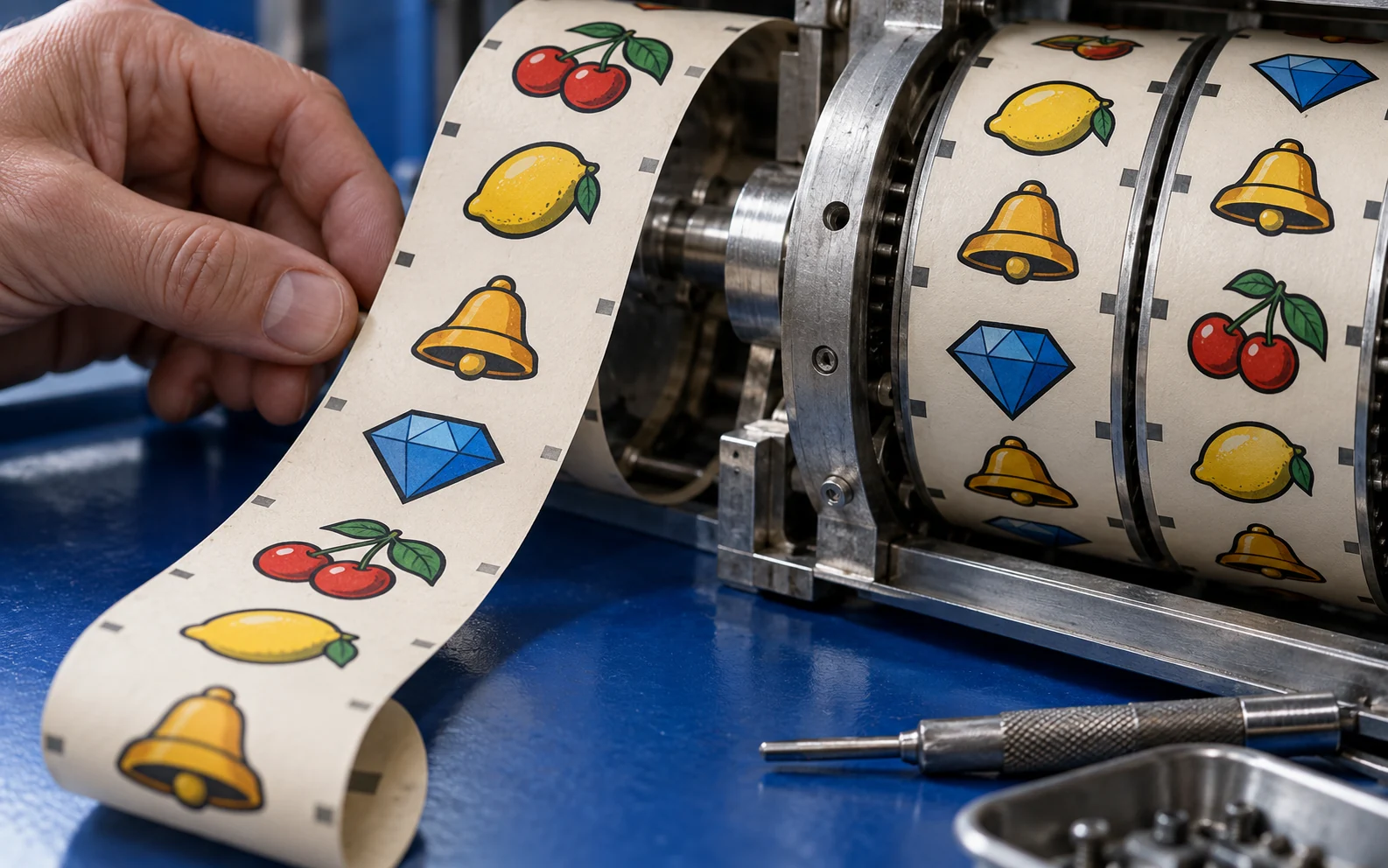
Slot screens are built on a handful of repeating parts, and that surface familiarity hides real mechanical variety. Two games can share a five-reel look while counting wins, treating symbols and changing state in completely different ways. Knowing which pieces are doing the work turns a blur of spinning icons into something you can read, and enjoy, on its own terms. The source description lists slots among Megapari's brand categories; that is a category reference, not a verified lobby, catalogue or set of connected games.
This piece stays with public mechanics rather than promises. It treats the screen as a small system: positions, functions, states. No spin is predicted here, no game is recommended, and nothing implies this publication runs accounts or moves money. The aim is the pleasure of seeing how a designed object is put together.
Geometry first: what a grid allows
Every slot starts with a shape. Classic three-reel machines offer narrow strips and few stopping positions; video slots widen to five reels and three rows, six by four, or irregular panels. The shape fixes how many positions exist, which combinations can form at all, and how much of the screen a single result can occupy. Play'n GO's Book of Dead, for instance, is described as a five-reel, three-row game with ten paylines, a modest frame by modern standards.
Paylines then decide direction. Most read left to right, so a match must begin at the leftmost reel; some pay both ways, some use ways-to-win counting where any adjacent-reel match of active positions qualifies, and cluster or anywhere-pays formats ignore lines entirely. Comparing games by reel count alone misses this: identical shapes can still qualify different positions, and the paytable must name its counting rule before any example arithmetic means anything.
Symbols that do more than one job
Slot symbols rarely sit in tidy categories. Ordinary symbols have paytable values, yet wilds and scatters can carry direct awards as well as substitution or triggering functions. A wild might complete a line and also pay on its own count; a scatter might start a feature and still appear in the paytable. Functions overlap, and the same icon may substitute, trigger and pay, depending on the version's written rules.
Book of Dead is a clean bounded example: its book symbol is described by the supplier as both wild and scatter, and the free-spin round uses a chosen expanding symbol. That is a game-specific arrangement, not a template. Reading a symbol means asking three separate questions — what it pays, what it substitutes for, what it starts — and treating the answers as potentially simultaneous rather than exclusive.
Rounds, respins and state that persists
A feature is a defined sequence, not a lucky spin. Free-spin rounds grant a number of spins under modified rules, often with an expanded symbol or altered reels; respins hold selected positions while the rest re-spin; cascading or avalanche mechanics clear qualifying symbols, let the survivors fall and refill the grid, possibly expanding rows as they go. NetEnt's Gonzo's Quest II returns to El Dorado with a six-by-four base grid, winning avalanches that may expand rows, a regular wild, a Calamity Wild, colossal symbols and separate free-spin features. Those are distinct roles within one sequel, not the original or its Megaways variant.
Some symbols persist through a feature: sticky symbols stay in place for the round's duration, expanding symbols stretch across a reel. How long either lasts, whether it can retrigger and what ends the round all come from that exact feature's rules, so durations should be read rather than assumed. Separately, feature-buy prices where offered are a display price for entering a round, not a forecast of return. And the source line advertising ₹1,00,000 plus 500 free spins is a marketing offer with incomplete conditions, 18+ and T&C apply — not the same thing as a game's free-spin feature, despite the shared phrase.
Reading the unit before the multiplier
A paytable converts symbol matches into multiples of a named unit, and that unit is the part most often skipped. Credits, coin denomination, line stake and total stake are different quantities; there is no universal formula that divides one by the other to find the paytable unit. The version's own rules say which figure its multiples apply to, and a hypothetical example must make that allocation explicit before any arithmetic holds.
Take an invented game with ten fixed paylines and a total stake of 100 units, deliberately allocated as 10 units per line. If the paytable awards five times the line stake for five matching symbols on a line, that line returns 50 units; several qualifying lines are added together unless the rules state otherwise. Suppose a feature applies a 2x symbol multiplier and a 3x feature multiplier under its written rules — combined that gives 6x, and swapping the order changes nothing unless the game defines a rounding step or cap. Multipliers stay in the terms; no intermediate operation is invented here. On a phone the panel may be collapsed, the stake selector simplified and the account display shown in rupees, so the unit has to be looked up rather than guessed.
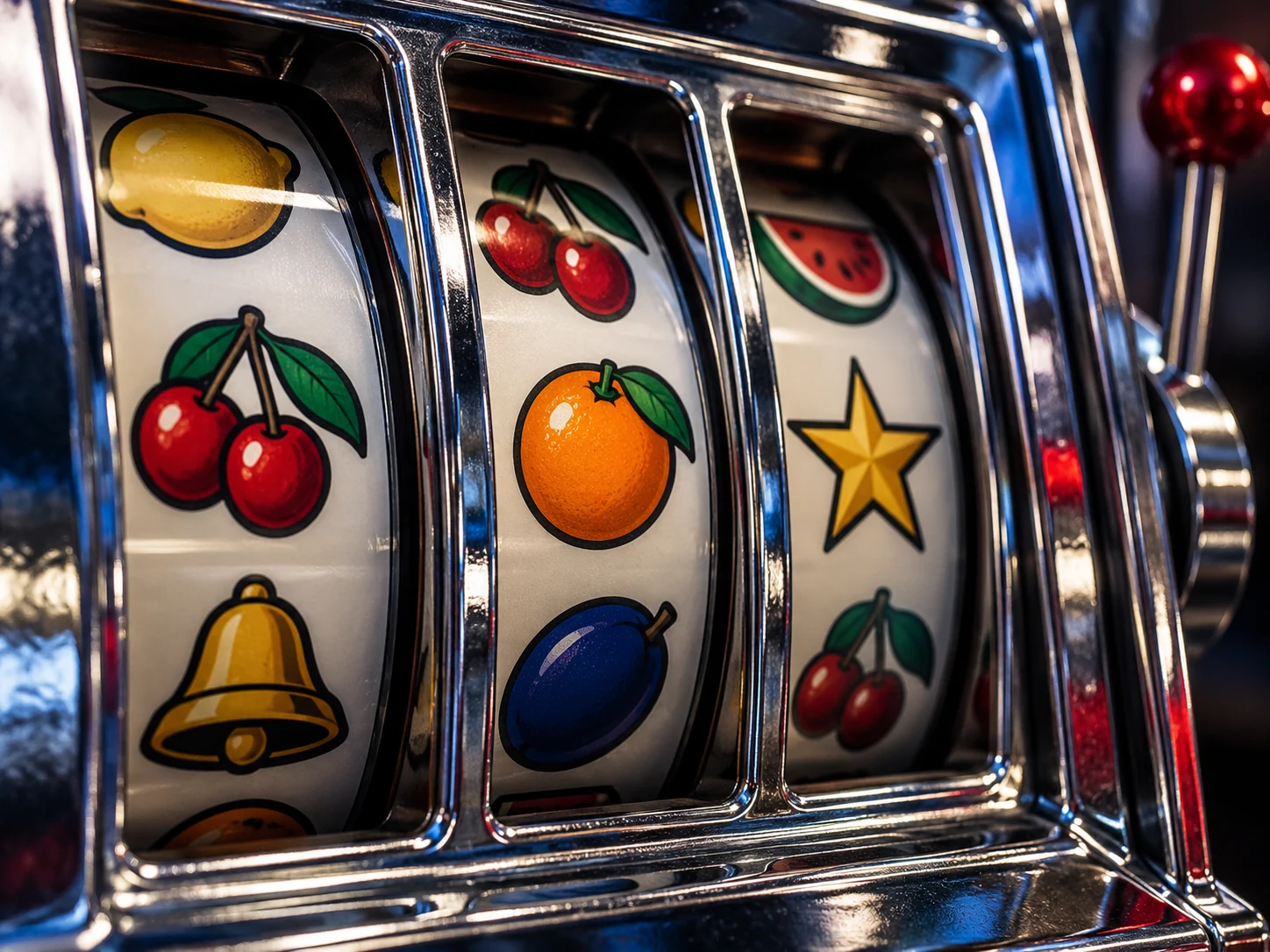
Return, spread and the sample in front of you
Theoretical return to player is a long-run proportion of total amounts wagered across extensive play, not an amount, a session target or a personal promise. A 96 percent figure describes performance over very large volumes; an individual evening can land far from it, which is precisely why the term is theoretical. The UK Gambling Commission's explanation makes the same point about percentage return. That source also separates fully random systems from compensated machines, a distinction about mechanism that should not be stretched into any claim about Megapari, UK regulation or India's market.
Volatility describes how outcomes spread around that long-run figure: frequent small returns or rarer larger ones. Hit frequency is related but not identical, counting the share of spins returning something. On fully random base games, each spin is independent of the last, so past results do not alter the next one. Persistent or changing features complicate the picture: identical behaviour should only be assumed within a defined state, because a feature's rules can change what happens next. Maximum win caps belong to the same design language — a limit written into the terms, not a target. Observed results are always a sample, never a measurement of the design.
Context around the screen
Much slot reading happens on a phone, where the paytable hides behind an information button and the stake selector shows a tidy currency figure rather than the internal credit structure. Mobile play is described by the source as smooth, with an INR balance and 24×7 help, but those are current-conditions claims rather than settled facts, and this publication neither plays nor processes money. It links to the full home utility for account and preview information; for currency, stake and request details, the full home payment notes are the right place, not a slot screen.
Offers deserve their own line. The source text advertises ₹1,00,000 bonus plus 500 free spins with 18+ and T&C apply, an incomplete marketing line whose deadlines, turnover and payment terms are unpublished and must not be filled in. It sits beside the games, not inside them: a promotional free spin is a term with conditions, a slot's free-spin feature is a designed round. Keeping the two apart is the difference between reading an offer and misreading a reel.
Why the differences matter
Set the documented examples side by side and the variety becomes concrete. Book of Dead's five-by-three, ten-line frame asks its book symbol to serve as both wild and scatter, and its free-spin feature uses a chosen expanding symbol as a separate element. Gonzo's Quest II opens a six-by-four base grid where winning avalanches can expand rows and several wild and free-spin roles coexist. Neither example says anything about what Megapari stocks or configures. They show that shape, function and state each carry part of a game's identity, and that a screen superficially similar to either can still count wins in an entirely different way.
That is where the interest lives. A held symbol, an expanding row or a doubled wild count changes the scene rather than simply improving a number. Understand the written version-specific rules and the display stops being a mystery — not because attention earns more, but because the mechanism is finally legible. Hypothetical cases used here illustrate rules; they do not prove any unseen screen right or wrong.
The pleasure of slots, once the surface is set aside, is architectural. A grid decides what can form, symbols juggle several jobs, and features shift the rules mid-round. Follow those threads and a wall of lookalike games separates into individual machines with their own logic and their own written terms.
None of that is a forecast, and this publication makes none. It writes, previews and explains; it does not run accounts, real-money games or payments. Read the version in front of you, and the screen becomes a designed object rather than a slot machine.